


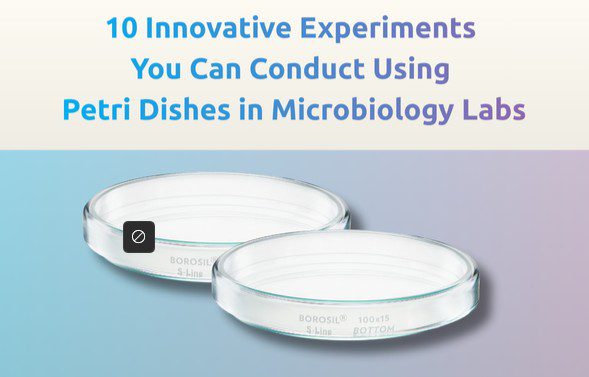
In microbiological research, Petri dishes are among the most commonly used pieces of lab equipment. Their flat and clear shape makes them ideal for visual monitoring and comparison studies, whether you’re growing bacteria or examining how antibiotics work against them. Whether it’s an introductory school lab or a pharmaceutical QC unit, petri dishes serve as foundational tools for conducting experiments that demand surface area, sterile conditions, and visibility.
This article compiles 10 scientifically relevant, practical, and occasionally creative experiments that can be conducted using standard or specialised petri dishes. Each one brings out the depth of use cases applicable across pharmaceutical, clinical, and academic labs.
- Bacterial Colony Morphology Observation
This experiment introduces beginners to the patterns of microbial growth. By streaking samples from surfaces, such as doorknobs, keyboards, or skin, onto nutrient agar, researchers can observe distinct colony shapes, colours, and edge characteristics. The incubation process takes 24-48 hours at 37°C, helping to identify possible contamination sources and teaching the basics of aseptic technique.
- Antibiotic Sensitivity Testing (Kirby-Bauer Method)
Used widely in pharmaceutical microbiology, this experiment assesses the efficacy of antibiotics against specific bacteria. Filter paper discs impregnated with antibiotics are placed on a lawn of bacteria—zones of inhibition form around effective drugs. The size of these zones is measured to determine resistance levels. CLSI guidelines should be followed to ensure reproducibility.
- Fungal Spore Germination Study
Potato Dextrose Agar (PDA) plates in Petri dishes are used to grow fungal spores from sources such as stale bread or fruit. This experiment is ideal for learning about the time it takes for fungi like Aspergillus or Penicillium to germinate, how hyphae branch, and how colonies appear.
- Air Quality Monitoring via Passive Sampling
Expose petri dishes containing general-purpose media, such as tryptic soy agar (TSA), to room air for 15-30 minutes. Microbes in the air settle and grow into colonies after incubation. This method, while qualitative, helps identify hotspots of airborne contamination in cleanrooms, production lines, or hospitals.
- Zone of Plant Extract Inhibition
Neem, tulsi, or garlic extracts can be applied to agar plates seeded with various types of bacteria to test their natural antimicrobial properties. Clear zones show antibacterial activity. In line with ethnopharmacology and bioactive compound screening, which are common in academic research, this experiment can be done.
- Biofilm Formation Assays
Biofilms are often formed by bacteria such as Pseudomonas aeruginosa and Staphylococcus epidermidis. Researchers can observe how these structures form by using nutrient-rich agar and controlling the incubation time in Petri dishes. Cross-sectional imaging reveals structure, and dyes like crystal violet aid in measuring biomass.
- Temperature Tolerance in Microbial Growth
Different temperatures (4°C, 25°C, 37°C, and 50°C) are used to grow the same strain of bacteria in Petri dishes. By looking at colony density and size, you can figure out the best conditions for growth and the temperature limits. This can be used right away in the microbiology of food and in testing the stability of drugs.
- Soil Microbiome Characterisation
Serial dilutions of soil samples are plated onto multiple types of media to encourage the growth of diverse bacteria and fungi. This experiment helps identify dominant species and their tolerance to pH, salinity, and heavy metals. Often applied in environmental microbiology and agricultural R&D.
- Antibiotic Cross-Resistance Profiling
This multi-layered experiment uses parallel petri dishes to test how bacterial isolates respond to families of antibiotics. If a strain resists ampicillin, does it also resist cephalexin or aztreonam? Such studies inform empirical therapy guidelines in hospitals and contribute to the surveillance of resistance.
- Yeast Fermentation Gas Capture
By inoculating sugar-based media with Saccharomyces cerevisiae, the metabolic output (mainly CO2) can be indirectly measured. When a cover slip or thin layer of parafilm is sealed loosely, bubbles form underneath, indicating active fermentation. Though unconventional, this is a smart way to visualise yeast respiration.
Choosing the Right Petri Dish for Experimental Accuracy
Not all petri dishes are built equal. Glass petri dishes are preferred for applications requiring autoclaving and reuse. Plastic dishes, usually made of polystyrene, are disposable and often used in clinical or GMP settings to prevent cross-contamination.
Here’s a quick comparison:
| Feature | Glass Petri Dishes | Plastic Petri Dishes |
| Autoclavable | Yes | No |
| Reusability | High | Single-use |
| Optical Clarity | Moderate | High |
| Cost Efficiency | Long-term | Short-term |
| Lid Identification | Marking needed | Pre-labelled (in premium models) |
Some laboratory-grade petri dishes come with white enamel printing that clearly marks the lid and base, which avoids the common error of inverted cultures. Models with flat inner surfaces make sure that media spreads uniformly, avoiding edge-thickening, which can distort zone measurements.
Products like the 3160 Petri Dish or 3165 S-Line Petri Dish from the Borosil Scientific line-up, for example, offer these advantages. The S-Line variant includes optically clear, bubble-free surfaces, essential when observing fine colony morphology or pigment diffusion.
The consistent quality and clarity that these features offer can be useful in tissue culture, antibiotic screening, and even environmental monitoring. The dish you choose may not seem important, but it does have a measurable effect on how well the experiment can be repeated.
Conclusion
Petri dishes are still an important part of any microbiology lab, whether they are used for simple microbial cultivation or complex resistance profiling. Because they are so flexible, they can be used in clinical, academic, pharmaceutical, and environmental settings. It’s not just convenient to use the right kind of dish for the experiment; it’s also scientifically correct.
Whether you’re designing a routine sensitivity assay or developing an original protocol, investing in precise and clearly labelled petri dishes like the 3165 S-Line or 3160 models from companies like Borosil Scientific can make the difference between usable data and inconclusive outcomes.
For researchers committed to quality, the tools you use reflect the integrity of your results. Choose wisely, culture responsibly.